

For millions of Americans who run their own businesses, work as independent contractors, or earn income through multiple channels, refinancing a mortgage presents a specific and well-documented challenge. The standard mortgage process was built around W-2 employment — predictable income, a single employer, and documentation that fits neatly into a conventional underwriting checklist. Self-employed borrowers rarely fit that mold, and the friction they encounter when trying to refinance is not a bureaucratic accident. It reflects a real gap between how income is earned and how lenders have traditionally been trained to verify it.
The assumption that self-employed borrowers must always produce two consecutive years of full tax returns is one of the most persistent misunderstandings in residential lending. It shapes how borrowers prepare, when they apply, and — in many cases — whether they apply at all. Understanding where that assumption comes from, why it is not always accurate, and what documentation pathways actually exist is the starting point for approaching this process with realistic expectations.
What the Self Employed Refinance Mortgage Process Actually Requires
The phrase “two years of tax returns” has become shorthand for an entire verification standard, but it is more of a default guideline than an absolute rule. Lenders are primarily trying to establish income stability and repayment capacity. Tax returns are one method for doing that — not the only method. For borrowers pursuing a self employed refinance mortgage, the key distinction is understanding which loan programs are being considered and what documentation each one actually accepts.
Conventional loans backed by Fannie Mae or Freddie Mac do generally require two years of self-employment history and corresponding tax returns. But that standard applies specifically to those programs. Outside of conventional conforming guidelines, a range of alternative documentation loan programs exist — often referred to as non-QM loans — where the rules differ significantly. These programs were developed specifically because a meaningful portion of creditworthy borrowers cannot satisfy conventional documentation requirements without misrepresenting the true nature of their finances.
Why Tax Returns Create Problems for Self-Employed Income Verification
The challenge with using tax returns as the primary income document for self-employed borrowers is that those returns are often optimized to minimize taxable income, not to demonstrate borrowing capacity. A business owner who deducts vehicle expenses, home office costs, depreciation, and other legitimate business expenses may show a net income on paper that is substantially lower than what they actually bring in. Lenders using adjusted gross income from Schedule C or Schedule E may calculate a qualifying income that doesn’t reflect how the borrower actually manages their finances or services existing debt.
This is not fraud or misrepresentation — it is how the tax code functions. But it creates a structural mismatch when the same document is expected to serve both a tax minimization strategy and a mortgage qualification standard. Borrowers who have operated this way for years often find that even with strong revenue and consistent cash flow, their tax returns produce qualifying income figures that appear insufficient under conventional underwriting rules.
The Role of Loan Program Selection in Documentation Requirements
Not all mortgage products are underwritten against the same documentation matrix. Program selection is one of the most consequential decisions in the refinance process for self-employed borrowers, yet it is frequently treated as a secondary consideration after rate comparisons. The program determines what documentation is acceptable, what income methodology the lender uses, and how much of the borrower’s actual financial picture can be presented during underwriting.
Choosing the wrong program early — typically by applying directly to a conventional lender without first mapping out documentation eligibility — leads to either a denial or a conditional approval that cannot be satisfied. Working with a lender or mortgage professional who is familiar with non-QM options before the application is submitted significantly reduces the risk of that outcome.
Alternative Documentation Methods That Lenders Actually Accept
Several documentation approaches have become standard in the non-QM lending space, and each addresses a different borrower profile. These are not workarounds or unconventional exceptions — they are structured underwriting methodologies with their own qualification criteria, pricing frameworks, and compliance requirements.
Bank Statement Programs
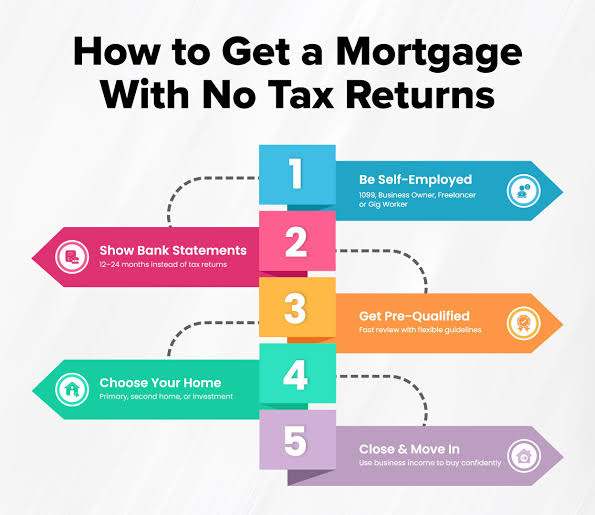
Bank statement loans use 12 or 24 months of personal or business bank statements to calculate qualifying income instead of tax returns. The lender reviews deposits over that period, applies an expense ratio to account for business costs, and derives a monthly income figure from the result. This approach tends to work well for borrowers whose businesses generate consistent, documentable cash flow even when net taxable income on returns is low.
The expense ratio applied by the lender matters considerably. Some programs apply a fixed ratio — using, for example, 50 percent of business deposits as qualifying income — while others accept a CPA-prepared expense letter that reflects the actual cost structure of the business. Borrowers with lower genuine expenses relative to revenue benefit from the letter approach, since a fixed ratio may undercount their true income.
Profit and Loss Statement Programs
Some lenders accept a CPA-prepared or accountant-verified profit and loss statement, either alone or in combination with bank statements, as the primary income document. This method is particularly useful for borrowers who have been in business for a shorter period or who experienced an unusual tax year that would distort a two-year average calculation. The profit and loss statement presents income and expense data directly, without the optimization layer that makes tax returns an imperfect verification tool for mortgage purposes.
Lenders using this method typically require that the statement be prepared by a licensed CPA and that it cover a specific period — often the most recent 12 months. The credibility of the document depends on the preparer’s qualifications, and lenders may request additional support documents such as business bank statements to verify the figures presented.
Asset Depletion and Asset-Based Qualification
For borrowers with substantial liquid assets but income that is difficult to document consistently, some lenders offer asset depletion programs. These programs convert verified asset balances into a monthly income equivalent based on a set formula — typically dividing total eligible assets by a fixed number of months — and use that figure for qualification purposes. This approach is more common in refinance scenarios where the borrower has significant equity and a strong net worth but irregular income patterns.
Asset-based qualification is not widely offered and tends to carry higher rates than bank statement or standard documentation programs. It is most applicable to borrowers in specific financial situations rather than a general alternative to income documentation.
Credit Profile and Equity Position in the Refinance Decision
Documentation method is one variable, but lenders evaluating self-employed refinance applications also consider the overall risk profile of the loan. Credit score, loan-to-value ratio, and property type all affect both approval likelihood and the pricing of the loan. For borrowers pursuing alternative documentation programs, these factors carry more weight because the lender is accepting a different type of income verification risk.
According to the Consumer Financial Protection Bureau, borrowers with stronger credit profiles and lower loan-to-value ratios consistently access better loan terms across product types. This relationship is particularly pronounced in non-QM lending, where the absence of agency backing means lenders are pricing risk without the same guarantees that conventional programs carry.
How Equity Affects Program Availability
Refinance applications in the non-QM space typically require more equity than conventional refinances. A borrower with 20 to 30 percent equity in their property will access more program options and better rate tiers than a borrower closer to the break-even threshold. Building equity before initiating a refinance application — either through time, property appreciation, or voluntary principal reduction — materially expands the range of available programs and improves qualification outcomes.
This is a strategic consideration rather than an immediate fix, but it is worth accounting for in timing decisions. A borrower who is six to twelve months away from a stronger equity position may benefit from waiting rather than applying under tighter conditions that limit both program access and rate pricing.
Common Mistakes That Delay or Undermine the Application
The refinance process for self-employed borrowers is more sensitive to preparation errors than it is for salaried applicants. Small inconsistencies between documentation sources, unexplained large deposits in bank statement reviews, or mismatched business structures can introduce underwriting questions that slow the process or create conditions that are difficult to satisfy.
• Applying to conventional lenders without first determining whether tax return income will meet their qualifying thresholds — this produces unnecessary hard credit inquiries and delays that affect the timeline for reapplying elsewhere.
• Using personal bank accounts for business transactions during the statement period under review, which complicates the deposit analysis and may require additional explanation letters that extend the underwriting process.
• Failing to maintain consistent business registration and licensing documentation, which lenders use to verify the existence and continuity of the business independent of income documents.
• Applying immediately after a significant change in business structure, such as a transition from sole proprietor to LLC, without allowing enough operating history under the new structure to satisfy lender requirements.
• Overlooking how recent debt obligations — particularly business credit lines that appear on a personal credit report — affect the debt-to-income calculation used in underwriting.
Closing Thoughts
Refinancing a mortgage as a self-employed borrower in the United States is genuinely more complex than the same process for a salaried employee. That complexity is real and worth acknowledging clearly. But it does not mean the process is inaccessible or that two years of clean tax returns are the only path forward. The lending market has developed structured, compliant alternatives specifically because self-employed income is legitimate, common, and increasingly diverse in how it is earned and documented.
The most effective approach starts with understanding which documentation method fits your actual financial situation, identifying the loan programs that accept that documentation, and preparing your financial records to present a clear and consistent picture before the application is submitted. Working with professionals who have direct experience in self-employed mortgage qualification — rather than applying through general-purpose lenders and hoping for the best — reduces the risk of wasted time and unnecessary credit exposure.
The barriers that feel fixed are often matters of program fit rather than fundamental eligibility. Addressing that distinction early is what separates borrowers who complete the process efficiently from those who spend months in an application cycle that was unlikely to succeed from the beginning.
