

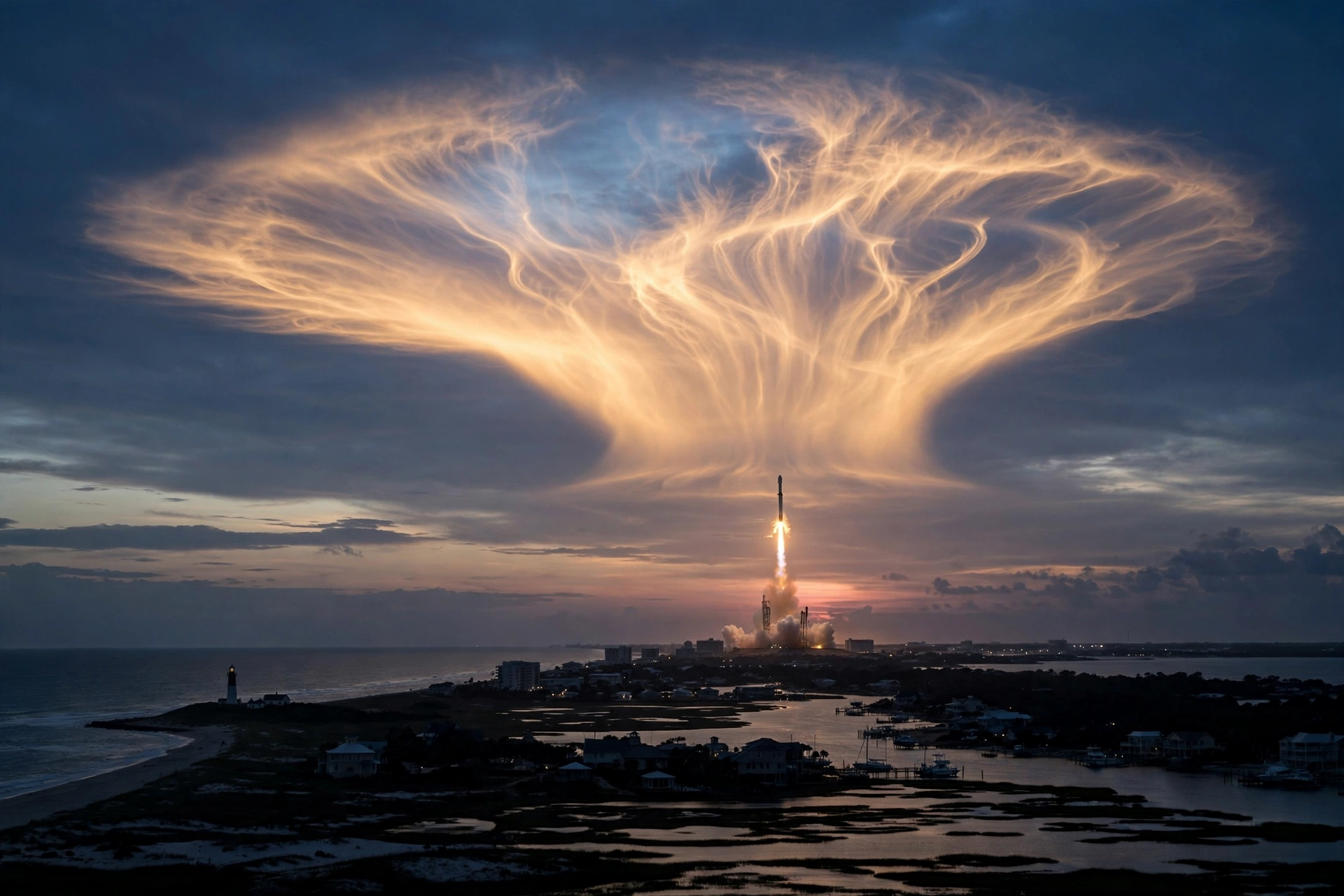
People along the United States East Coast looked up this week to find something extraordinary hanging in the twilight sky: a vast, glowing, jellyfish-shaped cloud drifting silently overhead. The spectacle, photographed from beaches, city rooftops and back gardens across several states, was not a weather event or a mystery object. It was the exhaust plume of a SpaceX rocket launch, lit by sunlight long after the ground below had slipped into dusk.
What witnesses saw
Shortly after launch, observers reported a bright point of light climbing into the sky, followed by an expanding fan of pale blue, pink and white vapour. Within minutes the plume had spread into the distinctive shape that gives the phenomenon its nickname: a rounded, luminous “bell” trailing long, delicate tendrils, much like a jellyfish drifting through deep water. Social media quickly filled with photographs and video, with many people admitting they had no idea what they were looking at until news reports confirmed the launch.
According to The Guardian’s report on the jellyfish cloud, the display was visible over a wide stretch of the East Coast, a reminder of how far a high-altitude plume can be seen when the lighting conditions are exactly right.
The science behind the “space jellyfish”
The effect, often called a “space jellyfish” or twilight phenomenon, happens when a rocket launches just before sunrise or just after sunset. At ground level it is already dark, but the rocket climbs quickly into air that is still bathed in sunlight. When the exhaust gases from the upper stage expand in the thin upper atmosphere, they form a broad cloud of water vapour and other particles. Sunlight striking that cloud from below the horizon makes it glow against the darkening sky, while the rapid expansion of gases in near-vacuum stretches the plume into its wide, translucent shape.
Because the exhaust expands so freely at altitude, the plume can grow to many kilometres across. Winds high in the atmosphere then pull and twist it, producing the trailing filaments that complete the jellyfish illusion. The colours shift as the display fades, moving from brilliant white through soft gold and pink, before the particles disperse and the show disappears.
Why twilight launches look so different
Daytime launches produce a familiar white smoke trail, and night launches a brilliant flame, but twilight launches occupy a dramatic middle ground. The contrast between a dark landscape and a sunlit plume is at its greatest, and the rocket itself can appear to leave a glowing ribbon behind it. Photographers prize these windows, and launch providers know that a well-timed evening flight can be seen by millions of people who never look at a launch schedule.
The science involved is not new. Similar displays have followed launches from Florida and California for decades, and researchers who study the upper atmosphere use them to understand how gases and particles move at extreme altitudes. The same curiosity that drives laboratory and imaging research — explored in our guide to choosing an automated cell imaging system — also drives the cameras that capture these fleeting events for analysis.
A growing rhythm of launches
The sight also underlines how routine orbital launches have become. SpaceX now flies so frequently that its rockets are a regular feature of coastal skies, carrying satellites, cargo and crews. Each mission adds to a busy orbital environment, and each twilight flight offers the public a free, unplanned astronomy lesson. For many witnesses, a jellyfish cloud is their first direct encounter with a launch they would otherwise only read about.
That visibility matters. Public support for spaceflight has always risen when people can see it for themselves, and few sights communicate the scale of a rocket’s climb as vividly as a plume that fills the evening sky. Astronomers and launch watchers advise anyone who enjoyed this display to watch future launch schedules: when a flight is timed for dawn or dusk, and the weather is clear, the East Coast may be treated to the show again.
What to do if you see one
If a strange glowing cloud appears after sunset, check launch schedules before assuming anything unusual. Photograph it quickly, because the display can fade within twenty minutes, and use a wide lens setting to capture the full plume. Most of all, simply enjoy it. The jellyfish cloud over the East Coast this week was a brief alignment of sunlight, chemistry and engineering — and a striking reminder that some of the best sky shows are now made by rockets.
